


Page 19 - NORWAY EXPORTS Maritime 2017-18
P. 19
“Hydrogen is very new,” said Mjøs. “One   new technology is not covered by current   Raufoss, DNV GL, Norwegian Directorate
                     of the biggest barriers is the need for   regulations.”           for Civil Protection and the Møre and
                     effective hydrogen specifi c rules.”                               Romsdal County Authority.
                                                      The HYBRIDShip project was formally
                     HYBRIDShip                       launched in January 2017. In the fi rst   Hydrogen Ferry Routes
                     Fiskerstrand Shipyard has launched a   phase of the project, the partners will   As part of another recent breakthrough,
                     project to build the world’s fi rst hydrogen-  focus on the technical and regulatory   the Norwegian Public Roads Administration
                     powered ferry under the Norwegian   requirements, testing of fuel cells under   (NPRA) announced last August plans to
                     innovation project HYBRIDShip. The   marine conditions, and develop procedures   contract a hydrogen-powered ferry to
                     project received research funding from   for fi lling and operating with hydrogen. The   connect three coastal towns offshore
                     the PILOT-E scheme to have a hybrid-  second phase of the project will focus on   Stavanger. The development contract is
                     powered ferry using battery and hydrogen   converting the selected ferry, as well as   similar to the one that made the world’s fi rst
                     technology. It is expected to be operating   testing, piloting and operating it.   electric passenger and car ferry Ampere
                     by 2020. The project will also potentially                        offshore Bergen a reality in 2015.
                     pave the way for bringing forward the   The hope is that the project will not only
                     authority’s approval process for using   develop the pilot vessel, but also build   “It’s a particularly important project due
                     hydrogen as fuel in maritime transport.  a specifi cation foundation that can be   to its authority backing and funding,” says
                                                      applied towards other types of hydrogen-  Gerd Petra Haugom, a DNV GL principal
                     “It is positive that the NMA now is   powered hybrid ships for other industries,   consultant specializing in hydrogen.
                     increasingly getting involved in innovative   such as aquaculture, fi shing, offshore
                     projects at an early stage,” says Olav   industry and short sea shipping. The    The contract calls for 10-years of zero-
                     Akselsen, NMA director general of   Norwegian partners in the HYBRIDShip   emission operation that will reduce CO
                                                                                                                  2
                     Shipping and Navigation. “This means that   project include the NMA, Multi Maritime,   emissions by more than 4,000 tons per
                     we are better prepared in cases where the   SINTEF Foundation, NEL, Hexagon   year. It is one of 11 zero-emission and low
                                                                                       emission maritime contracts that combined
                                                                                       could reduce CO  by 30,000 tons annually,
                                                                                                   2
                                                                                       equal to the emissions of about 15,000
                                                                                       cars. The hydrogen ferry will also push the
                                                                                       envelope for developing other types of zero
                                                                                       emission vessels.

                                                                                       “If we succeed with the hydrogen-powered
                                                                                       ferry, this will also have a transfer value
                                                                                       for other sectors of the maritime industry
                                                                                       which need longer distances than electric
                                                                                       power alone can provide, for example fast
                                                                                       ferries and other coastal traffi c,” says Terje
                                                                                       Moe Gustavsen, NPRA managing director.


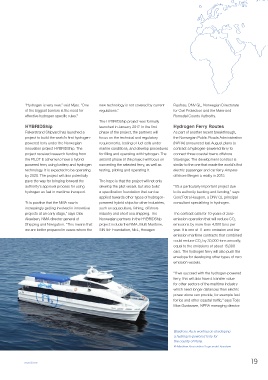
                                                                                       Brødrene Aa is working on developing
                                                                                       a hydrogen-powered ferry for
                                                                                       the county of Florø.
                                                                                       © Maritime Association Sogn andof Fjordane

                                                                                                                         19
                    maritime

