


Page 23 - NORWAY EXPORTS Maritime 2017-18
P. 23
offshore boat booms and then transform   is the immense amount of plastic that   The initiative aims to create concrete
                     the waste on board into synthetic diesel for   is not recycled. According to Bohn,   solutions that can turn the negative
                     use as ship fuel and re-sale to land-based   roughly 92% of the 300 million tons   environment development in the oceans.
                     markets.                         produced annually ends up in the dumps   The organization has already outlined plans
                                                      or in nature.                    for a new concept that collects plastic
                     Quantafuel has developed a unique                                 from the oceans with the goal of burning
                     catalyzer that turns plastic waste into   “Plastic is a big problem with a big cost,”   waste and marine debris collected at sea,
                     synthetic diesel, which contains less   says Bohn. “So it is an especially nice thing   including plastic on board. Each kilogram
                     greenhouse emissions than regular   to be able to present a solution for people   of waste burned in will become 110 kW of
                     diesel. The company fi rst uses traditional   dealing with plastic that can provide an   thermal power that will go into the ship’s
                     technology to convert several types of   income.”                 hot water circuits, without emitting CO2.
                     carbon resources, such as biomass,
                     plastic and potentially even coal, into   Researching Ocean Pollution  The Norwegian shipyard Vard will build
                     synthetic gas. Its catalyst then transforms   Another healthy ocean initiative was   the REV for delivery in 2020. The vessel is
                     the gas into synthetic diesel.   recently launched by the environmental   designed to sail all types of oceans, but will
                                                      organization WWF Norway and Norwegian   be particularly important for researching
                     The company has decided to start its   billionaire Kjell Inge Røkke. As part of the   the remote polar areas of the Arctic and
                     commercial rollout with plastic because   agreement announced last May, Rosselini   Antarctica. The advanced ship will boast
                     it is made of raw oil and very energy   Four-10, a subsidiary of Røkke’s company   a 40-seat auditorium and multiple labs.
                     intensive, says Kjetil Bohn, Quantafuel   The Resource Group, is developing a   Up to 60 researchers from many fi elds
                     managing director, during Enova’s   research and expedition vessel REV that   will simultaneously be able to work on the
                     conference in Trondheim last February.   will survey pollution and marine debris at   marine challenges putting pressure on
                     This means the plants can be smaller   the bottom of the oceans, as well as sea   marine life, such as temperature changes,
                     and less expensive. Another reason   acidifi cation.               sea acidifi cation, overfi shing, and marine
                                                                                       debris.

                                                                                       “Given the importance the ocean has for
                                                                                       food, health, energy, the environment and
                                                                                       climate, the ocean space is astonishingly
                                                                                       under-explored,” says Jan Gunnar Winter,
                                                                                       Norwegian Polar Institute director. “The
                                                                                       world needs a large-scale knowledge
                                                                                       acquisition in order to ensure a sustainable
                                                                                       development securing both usage and
                                                                                       protection.”


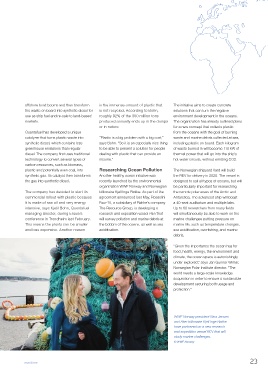
                                                                                       WWF Norway president Nina Jensen
                                                                                       and Aker billionaire Kjell Inge Røkke
                                                                                       have partnered on a new research
                                                                                       and expedition vessel REV that will
                                                                                       study marine challenges.
                                                                                       © WWF Norway


                                                                                                                         23
                    maritime

