


Page 16 - NORWAY EXPORTS Maritime 2017-18
P. 16
autonomous ships


                   go larger and greener


                     Norway’s maritime industry has swiftly evolved  expanded its focus from small-scale
                     driverless shipsboats , mostly small ferries, to larger autonomous offshore supply
                     vessels and zero-emissions container ship concepts.
                                                                                                   By Valeria Criscione


                     Norway has progressed rapidly in   technologies related to autonomous   electric and autonomous ship. The battery-
                     autonomous shipping with both the   shipping under the research programme   powered container ship will reduce NOx
                     number of test beds for new driverless   AUTOSEA, together with Kongsberg   and CO  emissions and remove 40,000
                                                                                            2
                     concepts and the scale of projects. Since   Maritime and Maritime Robotics.   containers from the roads by shipping from
                     the start of the Norwegian Forum for                              Yara’s Porsgrunn production plant to the
                     Autonomous Shipping (NFAS) last year,   As part of another pilot project, Norwegian   ports of Brevik and Larvik. The company
                     the number of members has grown to 50   industrial group Kongsberg, Risavika   calls Yara Birkeland a “game changer” for
                     companies, organisations and universities   Harbour in western Norway, shipowner   global maritime transport that meets the
                     participating in up to 10 autonomous   Seatrans, the Norwegian Coastal   United Nations’ Sustainable Development
                     shipping projects. The largest of these   Administration and DNV GL are developing   Goals (SDG).
                     could be Yara’s battery driven container   a battery driven container feeder concept
                     feeder Yara Birkeland, which could set a   for shuttling goods autonomously without   Disruptive Technology
                     huge milestone as the world’s fi rst fully   crew from Stavanger to Bergen. The   The environment has been a driving force for
                     electric and autonomous container ship.  pilot is part of phase two of the DNV   autonomous shipping in the wake of the Paris
                                                      GL-led initiative Green Coastal Shipping   Climate Agreement, increasing sulphur cap
                     “I would claim that it started with MUNIN,”   Programme, which aims to reduce the   regulations for global shipping, and the UN
                     says Ørnulf Jan Rødseth, SINTEF Ocean   volume of goods transported by road and   SDGs. Although not regulated by the Paris
                     senior researcher and NFAS manager. “In   reduce greenhouse gas emissions from   deal, the Norwegian maritime industry has
                     2012, nobody believed in this, but suddenly   ships.              taken signifi cant steps towards becoming
                     it exploded.”                                                     greener. Most recently, the Norwegian
                                                      Norwegian fertilizer producer Yara has   Shipowners’ Association announced plans
                     Reducing Road Transport          similar goals with its unmanned vessel.   last June to cut emissions in half by 2050,
                     SINTEF Ocean (then Marintek) was   Planned for operation by 2020, the Yara   and become carbon emissions free by 2100
                     technical advisor for the EU project MUNIN,   Birkeland could be the world’s fi rst fully   to help reach the SDGs.
                     a three-year concept study for unmanned
                     bulk shipping from 2012-2015. The aim
                     of the project was to study an unmanned
                     Handymax bulk carrier concept. Others,
                     such as classifi cation company DNV GL,
                     have simultaneously developed its own
                     autonomous cargo concept called ReVolt.

                     ReVolt is based on a 60-metre fully electric
                     unmanned shortsea vessel with a cargo
                     capacity of 100 twenty-foot containers.  A
                     small-scale model is currently being used
                     by the Norwegian University of Science
                     and Technology (NTNU) to test different


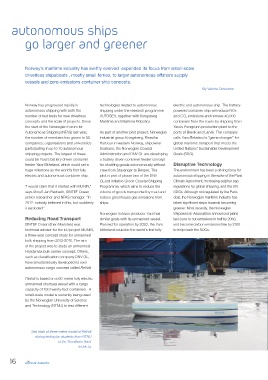
                        Sea trials of three-metre model of ReVolt
                         during testing by students from NTNU
                                   at the Trondheim fjord.
                                            © DNV GL

              16

